

At the organisation level, an agile transformation usualy consists in two interlaping phases: a transition to new ways of working and an evolution of the new ways onto business agility.
Continue reading “A thought on agility implementation”At the organisation level, an agile transformation usualy consists in two interlaping phases: a transition to new ways of working and an evolution of the new ways onto business agility.
Continue reading “A thought on agility implementation”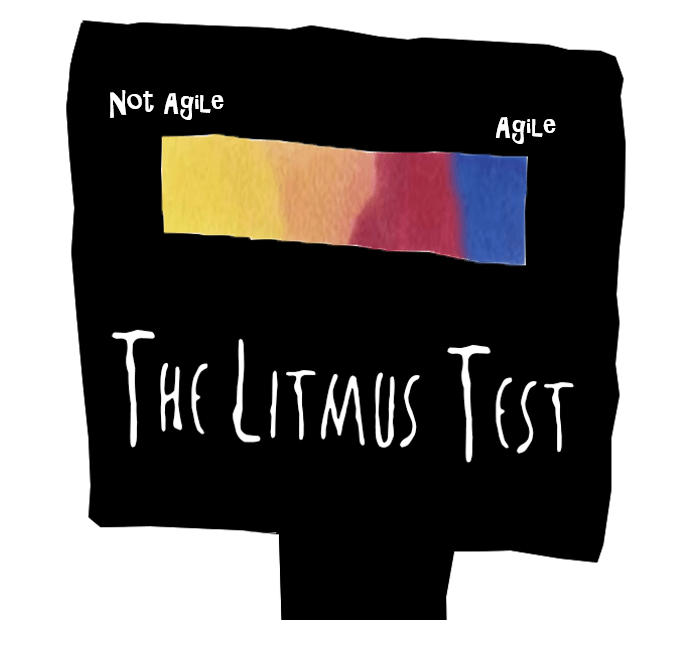
Agility is all about priority, simplification, cooperation, ownership, value delivery, feedback, and continuous improvement. The test could help teams assess their agility and identify areas that may provide improvements.
Continue reading “Team agility litmus test”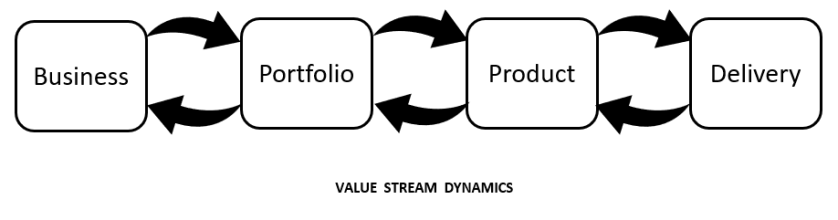
Needs define value, needs generate value add activities, and needs drive flow efficiency.
Continue reading “The dynamics of value generation through needs”
In a generative model we learn about needs by exploring the context, figuring out what knowledge will enable the right changes.
Continue reading “The AOS seen as a generative agility model”
When the organisation thinks about “moving to agile” or “adopting agile” commonly they think Scrum to form agile teams, then start the debate about how best to scale agile, SAFe, Scrum@Scale, Less, etc.
Continue reading “Simplifying the transition to business agility”
Business agility is hindered by operational silos, breaking these optimizes the flow of value.
Continue reading “Break silos for business agility”
The Agile Operating System facilitates the scaling of an agile transformation by promoting suatainable business agility . Sustainable agility and meaningful change relies on an ecosystem that supports new ways of working that extend from the team level to the executive level.
Continue reading “The AOS supports Business Agility”
This question is quite relevant and should be: does the organization need and want agility? How can we then implement it and express it?
Three phases to start an agile transition: the purpose (why), the context (because), the practice (how).
Continue reading “What agility for an organization?”
If I was asked to transform an organisation to new ways of working (WoW); agility being the key word; and I was given an hour to complete the task ….
Continue reading “An agile transformation in an hour.”
The Agile Operating System (AOS) addresses the value stream of an organization by identifying the relevant workflows that intervene in the business value creation process.
Continue reading “The AOS revisited”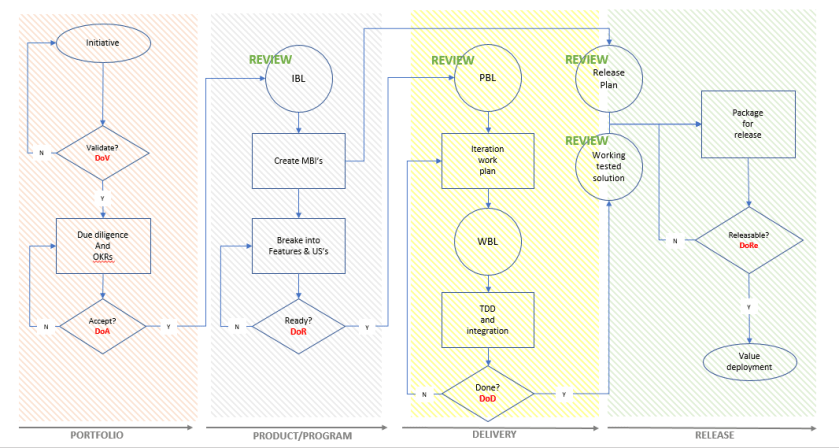
Business as well as technical initiatives flow through the value streams and the respective workflows in order to generate value outcomes.
Continue reading “Initiative to value delivery flow”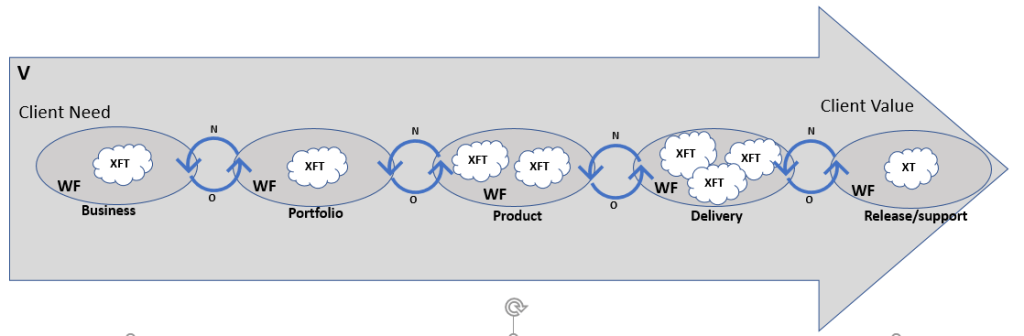
These concepts are all intimately related within the flow of value, as the value stream guides the way, workflows organize activities, the teams make value happen, and feedback loops allows for adjustment and pivoting.
Continue reading “Value stream, workflow, teams, and feedback loops”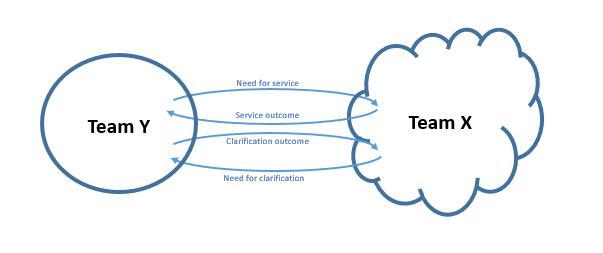
The relationship among teams is a continuous dual loop of needs and outcomes, the basic links bettween the workflows of a value stream.
Continue reading “The dual loop of needs and outcomes”
This is about how lean and agile principles come together in support of an ecosystem that allows the organization and its teams to express new ways of work (WoW).
Continue reading “The lean/agile fabric”
While examining an agility initiative and implementation look out for good, bad and ugly practices and conditions that are affecting the agile environment.
Continue reading “The good, the bad, and the ugly”
The Kanban Lens
In his blog Andy Charmichael defines the Kanban lens as follows:
The Agile Operating System (AOS) can be then analized through this lens as follows:
Continue reading “The AOS through the Kanban lens”
See the Agile Operating System (AOS) as a consensual chain of inter connected services:
– The AOS is a chain: sequence of services linked through feedback loops
– The AOS is consensual: work agreed is decomposed and handled by adjacent level service
– The AOS is inter-connected: blockers on work items affect other services

The evolution towards agility is achieved through an iterative and adaptive approach: the why it should be done, is backed up by the because it needs to be done, in order to define the how to do it.
Continue reading “Outcome of an agile transition”Handoffs are a sort of waste (they represent the transition from one ownership level to another, the equivalent to transportation as a sort of manufacturing waste) and the Lean nature of the Agile Operating System (AOS) aims at preventing waste.
Are there any handoffs within the AOS, and how are they dealt with?
The answer is NO!
Continue reading “The AOS and handoffs”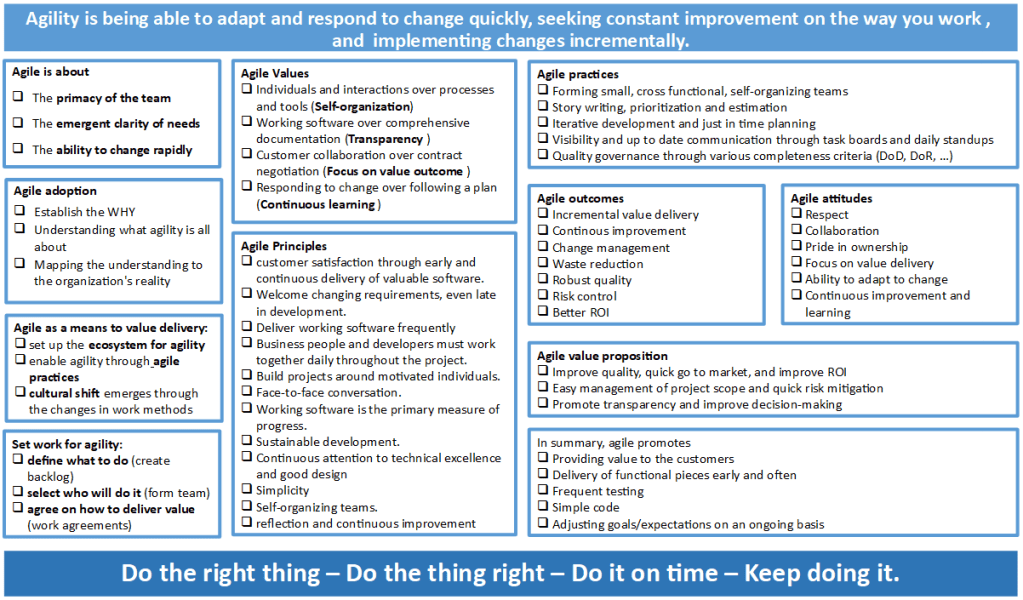
 Agile Ways