
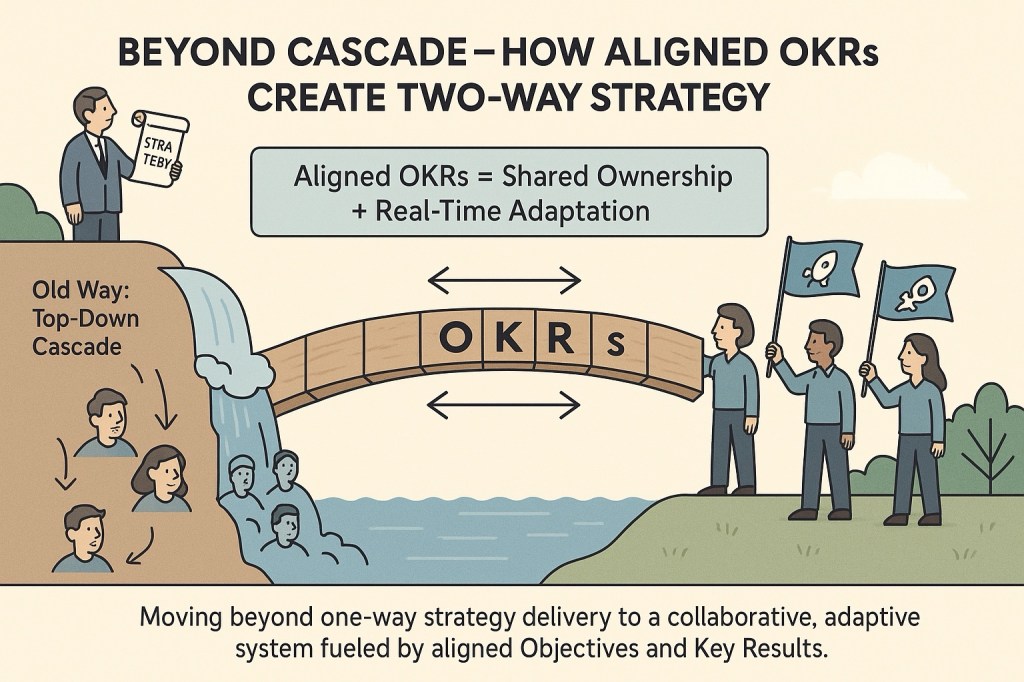
Most organizations get OKRs wrong. They create elaborate cascading hierarchies where executives set quarterly targets that flow down through management layers, eventually landing on individual teams as predetermined objectives. This top-down approach treats strategy as a one-way street—leadership thinks, teams execute.
But what if your quarterly OKRs could actually improve your multi-year strategy? What if the teams closest to customers and products could influence strategic direction while maintaining organizational alignment?
The Problem with Cascading OKRs
Traditional OKR cascades create several problems:
– Strategic Brittleness: When objectives flow only downward, organizations lose the ability to adapt quickly. Teams discover constraints, opportunities, and customer insights that never make it back up to strategic planning.
– Reduced Ownership: Teams executing someone else’s objectives feel less ownership and creativity. They optimize for hitting predetermined targets rather than discovering better ways to create value.
– Slow Feedback Loops: By the time quarterly results reveal strategic assumptions were wrong, it’s too late to adjust course meaningfully.
Alignment Over Cascade: A Better Way
Instead of cascading objectives, consider aligning them. This means creating nested outcomes across multiple time horizons where each level supports the others while maintaining authorship at every level.
Here’s how it works:
– Multi-Year Strategic Intent
Your organization’s vision and strategic intent operate at the multi-year level. For a digital banking company, this might be “become the primary digital banking provider.” This strategic intent is stable enough to guide long-term investments but flexible enough to evolve based on market learning.
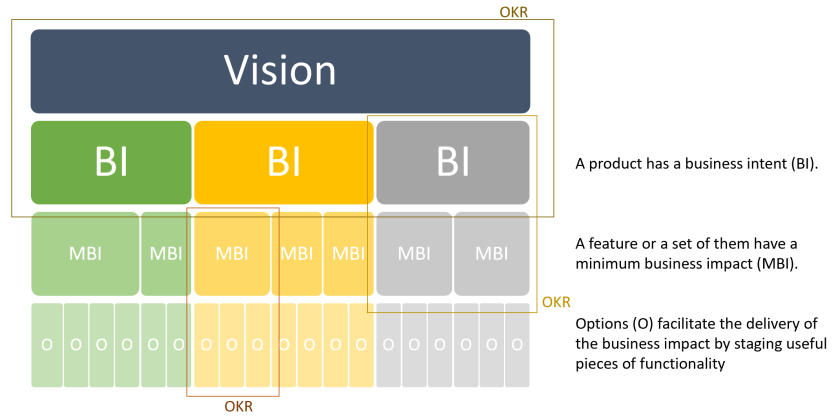
OKRs within a Business Backlog
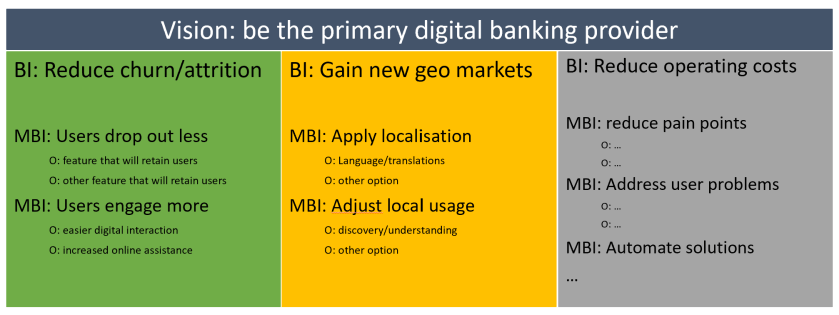
Banking example
– Annual Business Intents
Business intents translate strategic vision into annual focus areas. These aren’t detailed plans but strategic themes that guide resource allocation. Examples might include:
• Reduce customer churn and increase retention
• Expand into new geographic markets
• Reduce operational costs through automation
– Quarterly OKRs at Every Level
Here’s where the magic happens. Instead of cascading quarterly objectives, teams at every level—from divisions to individual pods—author their own OKRs that align with higher-level intents.
– Division-level OKRs focus on major business outcomes that support annual intents.
– Stream-level OKRs identify specific customer or product outcomes within their domain.
– Crew-level OKRs break down into testable hypotheses and measurable increments.
– Pod-level OKRs focus on specific deliverables and experiments.
The key insight: each level has the autonomy to determine how they’ll contribute to the level above, while the constraint of alignment ensures everyone pulls in the same direction.
Embedding OKRs in Your Value Stream
OKRs aren’t planning artifacts that sit in spreadsheets—they’re woven into how work actually flows through your organization. Consider a typical product development value stream:
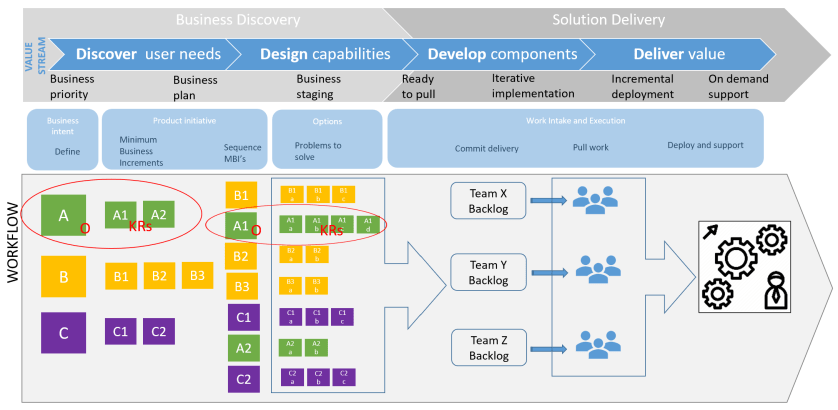
OKRs embedded into the workflow of the value stream
– Business Discovery Phase: Teams explore problems, validate opportunities, and sequence solutions. Their OKRs focus on learning outcomes—reducing uncertainty about what customers need and what solutions might work.
– Solution Delivery Phase: Teams build, test, and deploy solutions. Their OKRs shift to delivery outcomes—creating measurable value for customers and the business.
Throughout both phases, OKRs maintain traceability from tactical execution back to strategic intent. A pod working on a specific feature can trace their quarterly objectives through crew-level hypotheses, stream-level outcomes, and division-level business results all the way back to multi-year strategic intent.
Two-Way Strategy in Action
This alignment model creates powerful feedback loops that enable true two-way strategy:
– Bottom-Up Insights: When teams struggle to find meaningful quarterly objectives that support annual priorities, it signals potential issues with the broader strategy. When teams consistently exceed targets, it may indicate the multi-year strategy is too conservative.
– Strategic Agility: Organizations can adapt their approach while maintaining strategic focus. Teams can pivot their methods without losing alignment with overarching goals.
– Faster Learning: Quarterly cycles provide rapid feedback on the viability of annual goals and multi-year strategies. Strategic assumptions get tested every quarter, not every year.
– Teams of Teams: Horizontal Alignment
Cross-functional “teams of teams” play a crucial role in this system. They create horizontal alignment across organizational silos while maintaining vertical alignment with strategic intent.
Each team of teams develops OKRs that reflect their collective capability and shared accountability for outcomes. This prevents the common problem where individual teams optimize for their local objectives at the expense of broader system performance.
Making It Work: Practical Implementation
To implement aligned OKRs effectively:
– Start with Strategic Intent: Ensure your multi-year vision is clear and compelling enough to guide decision-making but flexible enough to evolve based on learning.
– Create Alignment Constraints: Give teams the autonomy to author their own OKRs within the constraint of supporting higher-level intents. This requires clear communication about strategic priorities and success metrics.
– Build Feedback Loops: Establish regular rhythms for sharing insights up and down the organizational hierarchy. Quarterly reviews should focus not just on results but on strategic learning.
– Measure Alignment, Not Just Performance: Track whether teams understand how their work connects to strategic intent. Misalignment is often more dangerous than underperformance.
– Embrace Emergence: Allow strategies to evolve based on quarterly learning. The best strategies emerge from the interaction between strategic intent and tactical execution.
The Result: Dynamic Strategy
When done well, aligned OKRs create a dynamic strategy system where long-term vision guides short-term action while short-term learning continuously refines long-term direction.
Organizations achieve the holy grail of strategic management: maintaining focus while staying agile. Teams can adapt their approach while maintaining alignment with overarching goals. Strategy becomes a living system that gets smarter over time, not a static plan that gets outdated.
The future belongs to organizations that can think strategically while acting tactically, that can maintain alignment while embracing emergence. Aligned OKRs aren’t just a better way to set goals—they’re a foundation for organizational intelligence in an uncertain world.
Ready to transform your OKR approach? Start by examining your current cascade model and identifying opportunities for teams to author their own aligned objectives. The journey from cascade to alignment isn’t just about changing a process—it’s about fundamentally reimagining how strategy and execution interact in your organization.

 Agile Ways