
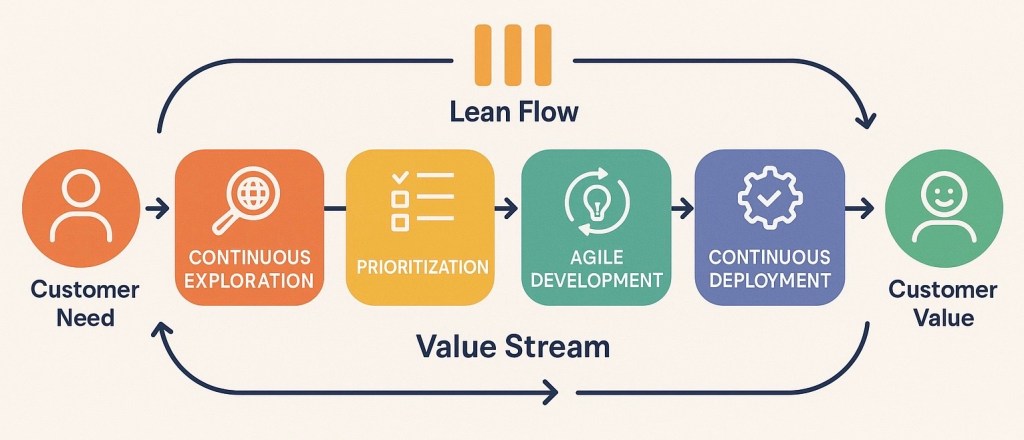
Organizations need more than just agile méthodologies to succeed in fast-paced business environments—they need a systematic approach to delivering value continuously and predictably. The key lies in understanding how value streams, lean flow principles, and embedded feedback loops work together to create truly responsive delivery systems.
Flow Starts with Purpose
“The delivery life cycle is guided by the value stream through lean flow.”
Every successful delivery starts with a fundamental question: What path does value take from conception to customer? This isn’t just about mapping processes—it’s about identifying the end-to-end journey that transforms ideas into meaningful outcomes.
When teams begin by mapping their value stream, they achieve something powerful: alignment on delivering outcomes rather than just outputs. Instead of focusing solely on completing tasks or shipping features, everyone understands how their work contributes to the larger value proposition.
Lean flow principles become the engine that drives this value delivery. By limiting work in progress (WIP), reducing unnecessary handoffs, and shortening cycle times, organizations create smooth, responsive delivery systems that can adapt quickly to changing conditions. This isn’t about working faster—it’s about working smarter by eliminating waste and focusing on what truly matters.
Clarity Through Definition
“The definition of the value stream clarifies roles and contributions, facilitating dual loops of needs and solutions, through a shift left approach.”
One of the most significant benefits of value stream mapping is the clarity it brings to roles and responsibilities. When everyone can see the complete picture, individual contributions become more meaningful and interdependencies become transparent.
This clarity enables organizations to establish dual learning loops that drive continuous improvement:
The Needs Loop focuses on understanding customer problems, market demands, and user experiences. Teams continuously gather insights about what customers actually need, not just what they say they want.
The Solutions Loop concentrates on evolving technical approaches, refining delivery methods, and improving product capabilities. This loop ensures that solutions remain flexible and can adapt as understanding deepens.
The shift-left approach becomes a natural outcome of this clarity. Instead of discovering problems late in the delivery cycle, teams bring critical activities—testing, risk assessment, user feedback, and quality assurance—earlier into the process. This proactive stance prevents issues from compounding and reduces the cost of change.
Momentum Through Feedback
“Wait time is reduced through faster feedback by attending to the needs within the workflow.”
Traditional delivery models often treat feedback as an external event—something that happens after work is complete. This approach creates bottlenecks, delays, and expensive rework cycles. The alternative is embedding feedback directly into the workflow itself.
When feedback becomes continuous and internal to the delivery process, several things happen simultaneously. Wait times shrink because teams don’t need to pause for external validation. Quality improves because issues are caught and addressed immediately. Learning accelerates because insights are applied while context is still fresh.
This internal feedback mechanism requires teams to be attentive to needs as they emerge within the workflow. It means creating space for reflection, building in checkpoints for validation, and maintaining open channels for communication throughout the delivery process.
Bringing It All Together
The integration of value streams, lean flow, and embedded feedback creates a delivery system that is both robust and responsive. Organizations that successfully implement these principles typically see three key improvements:
Continuous and Predictable Delivery: By understanding the complete value stream and optimizing flow, teams can deliver consistently without sacrificing quality or burning out team members.
Rapid Response to Change: When feedback loops are embedded in the workflow and dual learning loops are active, organizations can pivot quickly when market conditions shift or new opportunities emerge.
Enhanced Collaboration and Customer Value: Clear roles, shared understanding of the value stream, and continuous feedback create an environment where collaboration thrives and customer value remains the primary focus.
The path forward isn’t about implementing yet another methodology or framework. It’s about fundamentally rethinking how value flows through your organization and ensuring that every element of your delivery system supports that flow. When purpose guides flow, clarity enables action, and feedback drives momentum, organizations create the conditions for sustained agile delivery that truly serves both teams and customers.

 Agile Ways