
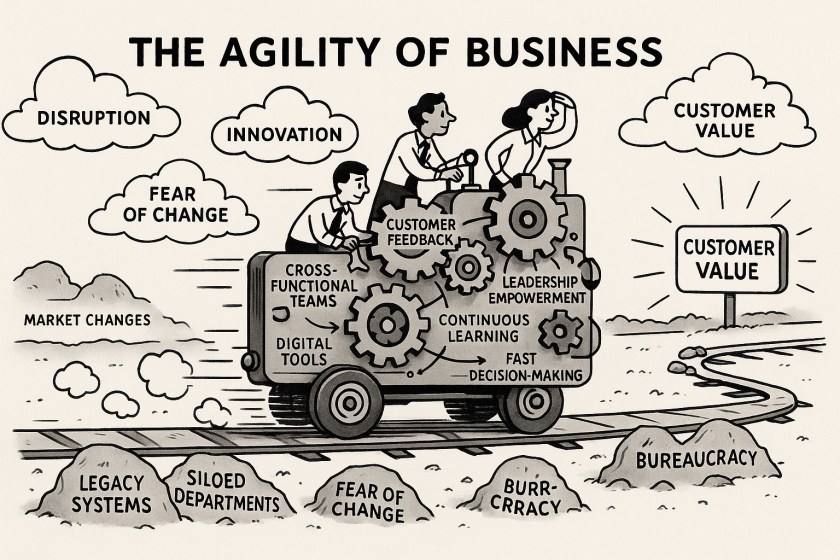
In rapidly changing environments organisations must be able to adapt quickly to varying market conditions, customer needs, and technological advancements. This is where business agility comes into play – a crucial capability that enables companies to thrive in uncertainty rather than merely survive it.
Understanding the Agility of Business
At the core of successful modern enterprises lies Business Agility – a good definition borrowed from Al Shalloway is, “the quick realization of value predictably, sustainably, and with high quality”, around which evolve a set of core components.
The illustration below presents a comprehensive approach to achieving this agility through interconnected components that work in harmony, a real system of agility.
The Core Components

The system consists of six key elements around the central concept of business agility:
- Management: Leadership that embraces agile values, empowers teams, and focuses on removing impediments rather than micromanaging.
- Team Structure: Cross-functional, self-organizing teams built around delivering customer value rather than traditional functional departments.
- Work Intake: Streamlined processes for evaluating, prioritizing, and accepting new work based on value and strategic alignment.
- Work Agreements: Clear expectations and commitments between teams and stakeholders about how work gets done, quality standards, and collaboration methods.
- Work Visibility: Transparent visualization of work flowing through the system, making bottlenecks, dependencies, and progress visible to all stakeholders.
- DevOps: Breaking down silos between development and operations teams to enable faster, more reliable delivery pipelines and foster a culture of shared responsibility.
The Virtuous Cycle
What makes this system particularly powerful is how these components interact and reinforce each other through continuous feedback loops, represented by the arrows connecting the outer green boxes:
- Higher Efficiency → Minimum Value Increment (reduce waste): As teams become more efficient, they can focus on delivering smaller batches of value, reducing waste in the process.
- Empirical Process → Small Frequent Release (lower risk): Data-driven decision making enables teams to release smaller changes more frequently, significantly reducing risk.
- Generates More Data → Continuous Iterative Improvement (increase efficiency): Each cycle produces valuable data that feeds back into the system, enabling continuous improvement.
Benefits Business Agility
Minimum Value Increment (Reduce Waste)
By focusing on delivering the smallest units of value that still meet customer needs, organizations can eliminate waste and ensure resources are directed toward work that genuinely matters. This approach prevents the common pitfall of over-engineering solutions or pursuing features with minimal customer value.
Small Frequent Release (Lower Risk)
Traditional big-bang releases carry enormous risk. By contrast, small, frequent releases allow organizations to:
- Get customer feedback earlier
- Limit the scope of potential failures
- Course-correct before significant resources are invested
- Build confidence through predictable delivery
Continuous Iterative Improvement (Increase Efficiency)
The framework promotes a culture of perpetual improvement where:
- Teams regularly reflect on their performance
- Processes are continuously refined
- Innovations in workflow and technology are embraced
- Efficiency gains compound over time
Business Agility in the Organisation
Business agility isn’t just about processes and tools—it requires a fundamental shift in organizational operations culture:
- Embrace failure as a learning opportunity
- Reward experimentation and innovation
- Focus on outcomes rather than output
- Invest in continuous learning and development
Focus on Customer Value
At every step, ask:
- Does this create value for our customers?
- Are we solving real problems?
- How quickly can we validate our assumptions?
Measure What Matters
Establish meaningful metrics that reflect real business value:
- Customer satisfaction and retention
- Time-to-market for new features
- Quality and reliability metrics
- Team engagement and satisfaction
Conclusion
Business agility isn’t a destination but a journey of continuous adaptation and improvement. Organizations that successfully adapt to this system position themselves to not only weather disruption but to thrive amid change. By focusing on the interconnected elements of DevOps, management, team structure, work intake, agreements, and visibility—all centered around quick realization of value—companies can build sustainable competitive advantage in an increasingly unpredictable business environment.
The system reminds us that business agility isn’t achieved through isolated initiatives but through a holistic approach where each element reinforces the others. When properly implemented, this creates a virtuous cycle of improvement that drives ongoing success and innovation.

 Agile Ways