
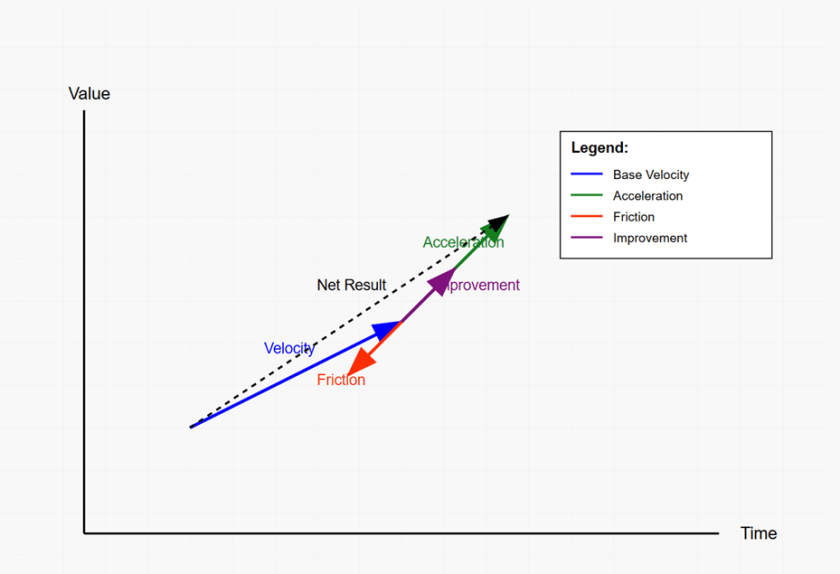
Software delivery is influenced by the interplay of several forces. Some are boosters and others antagonists, these forces simultaneously shape the challenges for development teams. Understanding these dynamics is essential to optimize software delivery processes, reduce time-to-market, and maintain competitive advantage while delivering high-quality products that meet customer needs.
Force break down
- Velocity (Base Value Delivery Rate) – blue vector: This is your fundamental rate of value delivery to stakeholders, measured in “value units” per time period (could be story points, features, or business value delivered). Influenced by team capacity, skills, and processes. Think of it as your team’s baseline performance when everything is working normally (like a car’s cruise speed on a flat road. Points upward and forward, showing positive value creation over time
- Acceleration (Value Discovery & Growth) – green vector: Represents positive changes in your delivery rate. Sources include: (i) Learning and implementing better practices, (ii) Team members gaining experience, (iii) Process optimizations being discovered, (iv) New tools or technologies that enhance productivity. Compounds over time if sustained. Similar to pressing the accelerator in a car. Often comes in bursts when breakthroughs happen. Can be temporary (quick wins) or permanent (systematic improvements)
- Friction (Impediments) – red vector: Acts against both velocity and acceleration. Common sources include: (i) Technical debt slowing down development, (ii) Communication overhead and misalignment, (iii) Context switching and interruptions, (iv) Outdated processes or tools, (v) Dependencies on other teams or systems. Tends to increase over time if not addressed. Like driving with the brakes partially engaged. Can be both visible (known issues) and invisible (systemic problems). Often accumulates gradually until it becomes a major problem
- Improvement (Corrective Actions) – purple vector: Deliberate interventions to enhance value delivery. Examples include: (i) Refactoring to reduce technical debt, (ii) Process improvements from retrospectives, (iii) Training and skill development, (iv) Tools and automation implementation, (v) Removing organizational impediments. Acts as a counter-force to friction. Most effective when systematic and continuous. Requires dedicated time and resources, like regular maintenance on a car.
The net result of all these forces combined is represented by the dashed black. It’s worth noticing how:
- The overall trajectory is still positive despite friction
- Improvement and acceleration help maintain upward momentum
- The system demonstrates both forward progress (time) and upward progress (value)
Key Interactions
Velocity vs. Friction:
- Friction directly opposes velocity
- Without intervention, friction tends to reduce velocity over time
- Teams need minimum velocity to overcome static friction
Acceleration vs. Improvement:
- Acceleration can be temporary, while improvement is usually permanent
- Improvements often enable better acceleration
- Both contribute to increased velocity
Improvement vs. Friction:
- Constant battle between entropy and order
- Improvement needs to exceed friction for sustained progress
- Preventive improvements can reduce future friction
System Dynamics:
- All forces interact continuously
- Changes in one force often affect others
- Net positive movement requires: strong base velocity, regular improvements, managed friction, and periodic acceleration
For optimal value delivery, teams should:
- Measure and maintain a stable base velocity
- Invest in systematic improvements
- Actively identify and reduce friction
- Create conditions that enable positive acceleration
- Monitor the overall system trend rather than individual metrics
This vectorial model helps visualize how investing in different areas (like reducing friction vs. increasing velocity) might affect your overall value delivery capability. The key is finding the right balance of forces for your specific context.
Strategies for managing each force
The management of value delivery forces can be organized into four major strategic areas, each focusing on a specific force while acknowledging their interconnections.
For velocity management, organizations should first establish solid measurement and baseline practices by implementing consistent tracking mechanisms and using relative estimation techniques. The key to velocity stability lies in maintaining consistent team composition, implementing work-in-progress limits, and creating standard iteration lengths while reserving capacity for unexpected work. Teams can enhance their base velocity through cross-training members, standardizing common tasks, building reusable component libraries, and documenting institutional knowledge.
To optimize acceleration, organizations should focus on three main areas: knowledge acquisition, process innovation, and tool enhancement. Knowledge acquisition involves regular technical learning sessions, external training programs, and conference attendance. Process innovation requires dedicated experimentation time, methodological testing, and proof-of-concept initiatives. Tool enhancement encompasses regular evaluation of new technologies, automation pipeline development, and integration of AI-assisted tools.
Friction reduction demands a multi-faceted approach centered on technical debt management, communication optimization, and organizational impediment removal. Technical debt should be managed through regular refactoring sprints, a scoring system, and adherence to the “Boy Scout Rule” of leaving code better than found. Communication can be optimized by establishing structured async channels, clear escalation paths, and maintaining a single source of truth for information. Organizational impediments should be tracked regularly, with root cause analysis sessions and clear decision-making frameworks.
The improvement implementation strategy requires a systematic approach with three distinct phases. The identification phase uses retrospectives, metrics analysis, and feedback loops to spot improvement opportunities. The prioritization framework evaluates improvements based on impact versus effort, cost of delay, and implementation complexity. The implementation strategy itself favors small, incremental changes with clear success metrics and regular progress reviews.
These strategic areas are supported by robust measurement and feedback systems tracking key metrics like cycle time, lead time, and team happiness. Risk management plays a crucial role through preventive measures and mitigation strategies, including regular assessments, contingency planning, and clear escalation paths. The entire system requires continuous adaptation through environmental scanning and adjustment mechanisms, ensuring the organization remains responsive to changing conditions.
Conclusion
Success in managing these factors requires a well-thought-out plan that starts with evaluation, builds a strong foundation, and continues to improve. Organizations can measure their progress through signs like steady or rising speed, fewer issues, happier teams, quicker cycles, better quality, and more satisfied stakeholders.
The key to managing these factors is understanding how they connect. A change in one area will impact others, so it’s important to take a balanced approach. Holding regular meetings to assess these factors, analyzing the effects of changes, and setting adjustment limits help keep everything balanced over different time frames.
To achieve lasting success, organizations should create a culture that encourages safety, learns from mistakes, celebrates improvements, and appreciates new ideas. This cultural base supports all strategic efforts and helps teams manage and enhance their value delivery over time.
In the words of Mike Cottmeyer: Fix the friction, and momentum follows.

 Agile Ways