
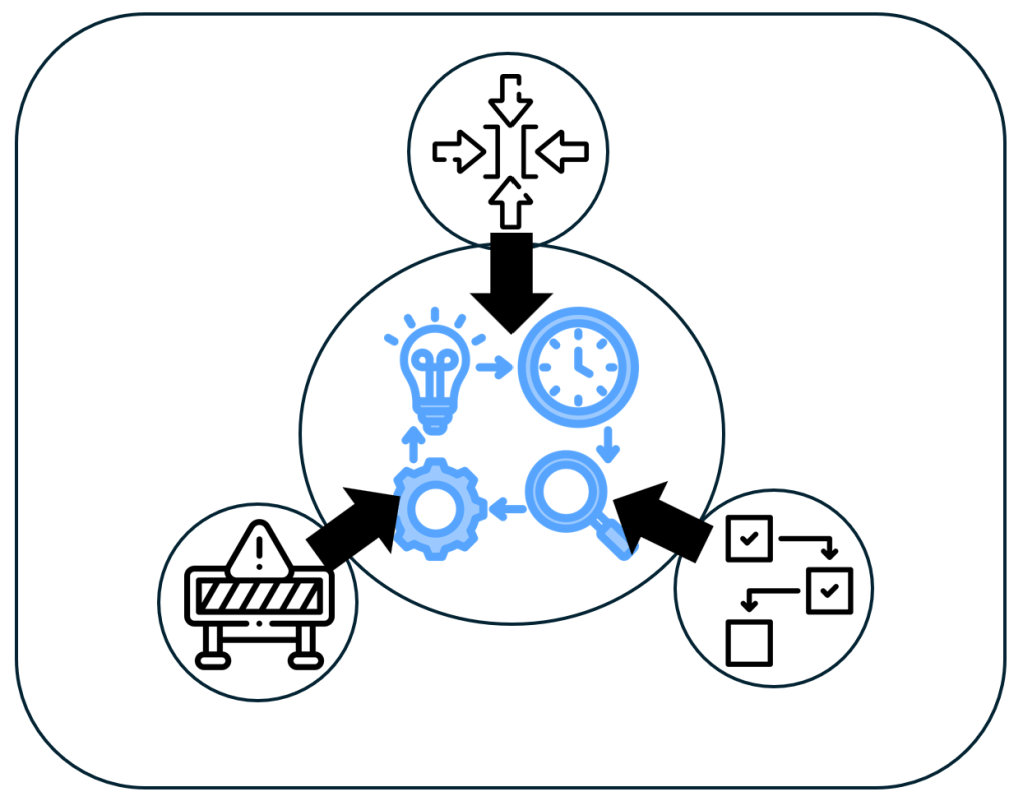
Knowledge work is characterized by cognitive complexity, creative problem-solving, and intellectual value generation. The challenges in this domain are primarily intangible and systemic.
OVERVIEW
The following overview was the product of a brain storming and analysis session with teams within a value stream whose efficiency was hindered by constraints, dependencies, and impediments.
Constraints
Two types of constraints were identified, structural and cognitive ones.
1. Structural Constraints
These are mainly around organisational hierarchy, resources allocation, and technology infrastructure.
– Vertical communication structures and bureaucratic layers impeding information flow and decision-making speed.
– Limited budgets, time, and personnel create boundaries for work scope and execution.
– Available tools although enablers, somehow restrict knowledge worker capabilities
2. Cognitive Constraints:
These involve attention management, context switching, and mental fatigue:
– Limited cognitive bandwidth and increasing information complexity
– Frequent interruptions and multitasking reduce deep work potential.
– Sustained intellectual effort leads to diminishing returns in creativity and problem-solving
Dependencies
These are if two kinds,
1. Interdependence, where collaborative requirements, information ecosystems, and complementary skills play a significant role:
– Most knowledge work involves intricate team interactions and cross-functional dependencies.
– Knowledge workers rely on complex networks of shared information, expertise, and communication channels
– Different team members’ specialized skills must integrate seamlessly to achieve collective outcomes
2. Systemic, through project sequencing, communication protocols, and learning dynamics:
– Early work phases critically influence subsequent stages.
– Effective knowledge transfer depends on shared understanding and communication quality
– Continuous skill development and knowledge acquisition are essential for maintaining competitive effectiveness
Impediments
These are mainly of two different nature, organisational and psychological:
1. On the organisational side,
– poorly structured communication events consume productive time
– unclear objectives, ambiguous goals, and undefined success metrics reduce worker motivation
– micromanagement and excessive control mechanisms stifle creativity and autonomous problem-solving
2. On the psychological side,
– self-doubt reduces confidence and risk-taking capacity
– prolonged stress and emotional exhaustion diminish cognitive performance
– lack of meaningful challenges and recognition can lead to disengagement
INSIGHTS
Key identifying factors
- Constraints in knowledge work are more fluid and psychologically oriented,
- Dependencies are network-based and non-linear,
- Impediments are predominantly cognitive and systemic
Mitigation Strategies:
- Implementation of adaptive organizational structures
- Development of robust communication frameworks
- Prioritise psychological safety and continuous learning
- Creation of flexible work environments that support deep concentration
- Leverage of collaboration technologies
Emerging Trends:
- Remote and distributed work models
- AI-augmented knowledge work
- Increased focus on individual cognitive optimization
- More holistic performance measurement approaches
CONCLUSION
By understanding these multifaceted dynamics, the value stream could design more effective knowledge work environments by minimising constraints, optimising dependencies, and reducing productivity impediments.

 Agile Ways