

An attempt to a systemic approach for an organization’s successful implementation of agile, leading to new ways of working and a cultural change.
A three-way approach
Succeeding with a transition to new ways of working is about executing change through understanding the new ways. The approach consists of three parts: understanding through sense making agile (comprehension process), transforming through sense making change (system of change), and executing through sense making delivery (system of delivery).
3-way approach to agility
- Sense making agile will help establish the adequacy of the new WoW to support the organization’s vision, context, and practices, it will clear the WHY are we doing this,
- Sense making change will ensure that the transition begins where it should, at the system (structure) level, through practices, on to cultural shift, and
- sense making (set up for) delivery, by establishing what to do, by who, and how, will baseline the agile practices required to drive the transformation.
Understanding
Agile, as a value-add approach, needs to be fit for purpose, fit for context, and fit for practice. In other words, how will agile help us achieve our goals? how do agile principles and values resonate with our current reality? and, what practices will best drive our agility?
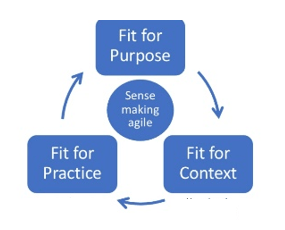
Understanding: WHY a new WoW and what does it mean
The three questions answered sequentially will provide the basic understanding and verification that agile is adequate for the organization. It will clarify the existing gaps between the current as-is and the future to-be, hence highlighting the focus areas to attend to. Setting an agile supporting ecosystem will help choose the best and appropriate practices to express agility.
Understanding will baseline the system of change.
Transforming
For viable change to be effective it should start at the system level where an environment is to be set for agile to happen and flourish. Needs should be understood and cared for, workflows defined for efficiency, inspect and adapt will drive the work in progress, where it is safe to fail and learn.
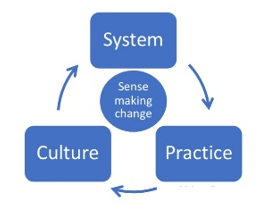
Transformation: WHAT needs to change
Such an ecosystem sets the base for agile practices, like customer focus, transparency, self-organization, and continuous learning all of which are assimilated by established organizational elements like governance, organization, operations and infrastructure, architecture, etc.
In this minimum viable environment (structure), the chosen practices will allow agile to happen, encouraging new habits (behaviors), that with time will shape up a new emergent culture (beliefs).
Transformation is the outcome of the system of change.
Executing
This final way refers to delivering the right thing, the best way possible, and on sustainable cadence, while learning and adapting as quick as possible.
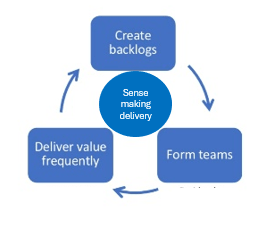
Execution: HOW will we operate
It supports the two previous ways, where coherent backlogs are created (create the right thing) to feed value streams, appropriate teams are assembled to consume the backlogs with all the necessary capabilities to minimize dependencies (deliver the right thing right), and there’s an agreement set in place to deliver value frequently (keep on delivering working tested valuable things).
Execution is at the heart of the system of delivery.
Conclusion
If the organization is to adopt agile ways of working to leverage their vision and goals, both systems of change and delivery are essential for the path to organizational agility and further business agility. The system of change thus needs a system of delivery in parallel to produce what agile is supposed to be: quick and alert while delivering value, accelerate learning, and avoiding waste.
Therefore, applying generative thinking, through understanding agile we learn and organize our agile transformation, by which we learn and implement agile execution patterns, by which we learn and adapt our understanding.

 Agile Ways