
I have previously explained Simple Agility and now would like to expand a little about how teams can use these concepts to change their ways of working or just improve the way they work.
Once a team understands the basics of simple agility, its guiding values and operational fundamentals, the team can decide which themes (practices) are best suited for them to express their agility.
For a team to embrace agility it must first understand the basic values of agility, in other words they must comprehend the importance of value delivery and focus, the advantages of self-organization, the use of transparency, and the need for continuous learning and improvement. These four basics are a mere reflection of the values expressed in the original Agile Manifesto. The team must reflect, search for answers, and adapt.
This understanding will allow the teams to assess the existing gap with their current context and hence the change needed to transition to the new way of working. I call this “fit for context agility”, which will model the minimum suitable ecosystem [for agility].
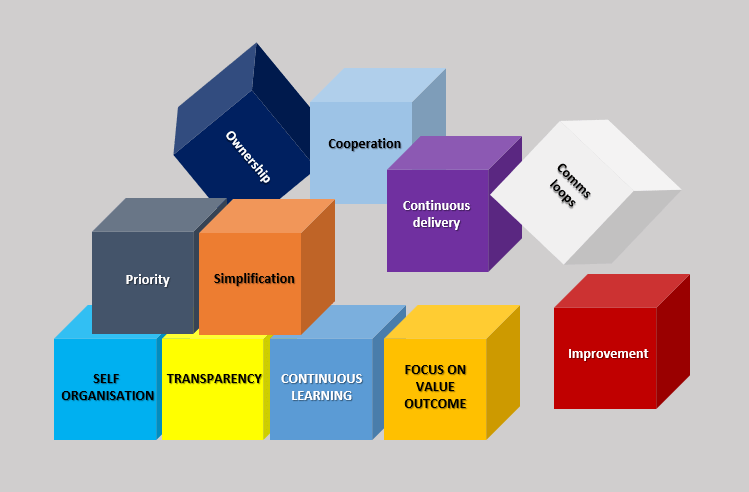
The operating fundamentals of agility can then be stacked upon each other in pursuit of value outcomes, by simply carrying out basic actions: the team working on the most important thing first (priority) by seeking to decouple the work items (simplicity) in order to focus and complete the task before starting new work (ownership); seeking and providing help (collaboration) to deliver value on cadence (continuous delivery); getting feedback as often as possible (feedback loops) to learn and adapt (improvement).
As the team gets comfortable living the guiding values, and find a sense adopting the operating fundamentals, it may be time to begin structuring the work around a purpose to deliver value, handle change, and reduce waste. The bases need to be cemented looking into what work needs to be done (value backlog) and by who (team organization), while defining how value is to be delivered (work agreements).
The work agreements will shape how work is taken, engagements among team members, outcomes delivery, and communication structure:
- Work – simplified, prioritized, and completed
- Engagements – cooperate, deliver, and get feedback
- Outcomes – valuable, of quality, and improvable
- Communication – next work, transparency, alignment, and validation
The next step is for teams to decide what themes will help carry out the working model defined above. Although such themes are essential, there are no prescriptions around how to create and manage the work backlog, nor how the team organizes itself; neither how they chose to prioritize and break down work, nor the exit criteria to done; how they accept work, the cadence for integration and delivery, and what feedback loops they implement; how they structure value delivery, ensure quality and the way they improve; how they choose the communication structure to decide what to work on next, verify alignment towards the goal, validating deliveries and measuring progress and performance.
It is because the team understands the problems they are trying to solve and the value they intend to deliver, that they will self-organize to establish the above themes. Through a discovery process they will be able to inspect their work model and adapt it to their present reality.
The simple agility implementation is part of the value delivery stream and as such needs to be aligned with the vision and business intentions that shape the goal the team pursues. Checking points for adequacy can be set through inspection of fitness criteria for purpose, context, practice, and learning: is simple agility in line with what we want to achieve, is it suited to present reality and circumstances, is it easy to carry out, and does it allow for adjustments?
Finally, by pursuing simple agility teams look to produce value frequently, while working closely with the value consumers, adjusting work continually based on current knowledge, and eliminating waste for improved efficiency.

 Agile Ways