

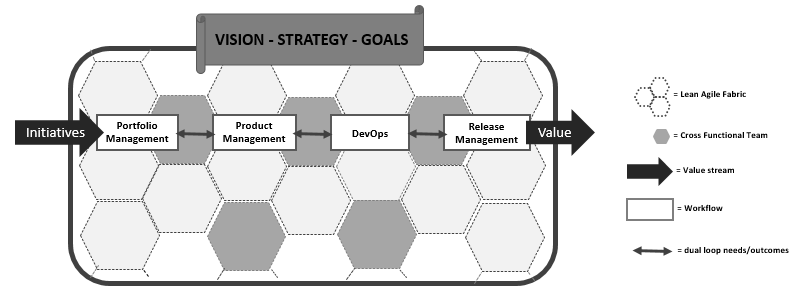
This is about how lean and agile principles come together in support of an ecosystem that allows the organization and its teams to express new ways of work (WoW).
Through a vision of agility and establishing the WHY of the transition to new ways of work the organization starts understanding lean agility values and principles. It sort of starts weaving the lean agile fabric, planting the seeds for a lean-agile ecosystem. agility will become part of the organization’s cultural DNA.
Workflow, commitment, visibility, empowerment, communication, collaboration, value quality, improvement, optimization, trust, etc., are all principles that’ll establish a safe environment for lean and agile practices to flourish.
A way to understand the gap an organization faces between their actual WoW and lean agility is by understanding lean agile values and principles and mapping them to the organization actual cultural values and principles. The gap between both will provide a view into the problems the organization needs to deal with in order to create a suitable ecosystem for agility.
Therefore, the transition to agility starts with a deep understanding of the necessary change needed to transform the system. The actual state of work of an organisation is a system of delivery, which will change through the outcome of a system of transformation (system concepts borrowed from Dennis Stevens from Leading Agile).
We need to start working upon the system to facilitate the work within the system: lay the fundations for the lean agility ecosystem, identify value streams, form cross functional teams around a value objective, chose/create an agility method to produce value, agree on delivering value outcomes frequently, and inspect and adapt according to needs.

 Agile Ways