
The organization’s reasons and motivation to follow the agile way will shape the transition towards agility; which in general is driven by some sort of business outcome. The Agile Operating System (AOS) is a model designed to enable an organization’s agile evolution. The model focuses on setting up an operating system that will support agility by encouraging organisational re alignment – agile discovery at portfolio and product level, followed by agile delivery at engineering and infrastructure level (DevOps).
The agile system is composed of several value creating processes (Portfolio Management, Product Management, Delivery Management, Infrastructure Management, and Release Management) that add up to the organization’s value delivery chain.
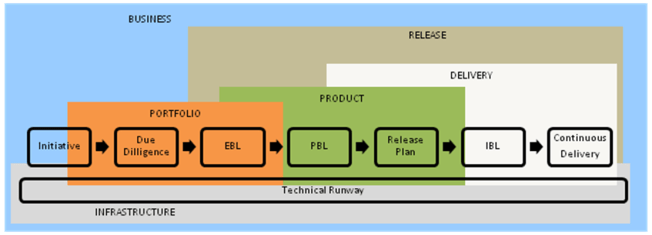
Each process functions following agile/lean values and principles, and in order to enable agility, practices are chosen in line with the organization’s ways of work and the vision to achieve business goals. The recommended agile practices could be time boxed iteration for delivery process, and flow management for all other processes.
In support of both the agile system and practices, people within the organization will begin adapting to the agile working ways, and a new work culture is likely to emerge.
Note: this analysis is inspired by the thoughts of Mike Cottmeyer of LeadingAgile

 Agile Ways