

“Essentially, all models are wrong, but some are useful.” – George Box, 1976
The enterprise Agile Operating System (AOS) is an engagement model designed to improve the organization’s way of work by encouraging behavioral change in line with Agile/Lean principles. The AOS goal is to improve the organization operations through four main agile fundamentals: self organization, transparency, customer value focus, and continuous improvement.
Definition of the AOS
The AOS is modeled by fit for purpose, interactive workflows and accountable teams. It defines a system driven by agile/lean principles and practices, aligned to an Enterprise vision, to deliver continuous quality to the market. It serves to bridge business agility with agile execution, and provides a means to achieve the organization’s vision of an agile transformation.
The value-based, descriptive and outcome-oriented workflows at the Portfolio, Product and Delivery levels, defines the organization value chain to deliver continuous quality to the market. It encourages behavioral change in line with Agile/Lean principles.
Use of the AOS
The agile system is used to:
- deliver value while embracing change and reducing waste,
- seek quality by building the right thing and building the thing right,
- produce value increments in an iterative manner allowing for continuous improvement,
- operate workflows within an agile/lean organization by cross functional teams,
- execute work on a pull system leveraging work capacity,
- always prioritize the demand for work,
- promote commitment, ownership, visibility, communication, cooperation and trust.
Underlying Concepts
“Agile is about working smarter, rather than harder. It’s not about doing more work in less time: it’s about generating more value with less work.” – Steve Denning
Three main concepts are at the heart of the AOS:
- Agile software development: a set of methodologies based on iterative and incremental development, where requirements and solutions evolve through collaboration between self-organizing, cross-functional teams.
- Lean thinking: a business model and collection of methods that focuses on maximizing customer value and minimizing waste, while delivering quality products on time and at least cost.
- DevOps: a cultural shift where Development and Operations function as one team, focused on delivering business value streamlining across the IT value chain.
AOS Components
The AOS consists of interactive workflows: Portfolio Management, Product Management, Delivery Management, and IT Infrastructure. These are aligned under a common vision and guided by the business. The AOS processes business and technical initiatives, product roadmaps, solutions, projects, etc., through the value delivery workflows that generate value added outputs such as the Enterprise backlog, Product backlogs and working tested software. Each workflow uses a defined agile delivery approach to deliver value inputs to the following workflow in the value chain. Feedback loops are installed at all levels of the system to facilitate direct communication and continuous improvement.
The IT Infrastructure service provides the technical runway that enables the value chain flow and agility. This unit, through agile/lean practices, seeks to secure a coherent technical architecture aligned with the organization’s compliance and security rules.
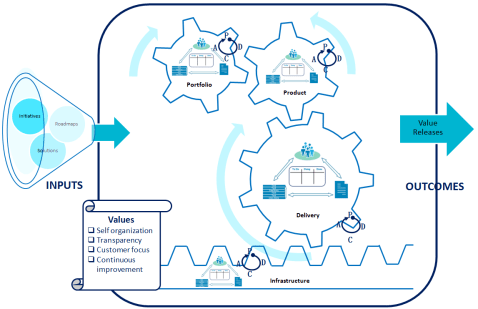
Each workflow is set for agility by
- defining what needs to be worked on (backlogs),
- choosing who does the work (teams)
- agreeing on how value is delivered (work agreements)
The AOS organizes the necessary workflows and outputs as follows:
Portfolio management workflow
- Purpose: to know what the organization needs to focus on in order to delight their customers and excel in the market.
- Main output: Enterprise backlog and Risk backlog
Product management workflow
- Purpose: to drive value out of the delivery teams, having all the tools and skills needed to deliver a clear backlog to the delivery team to execute.
- Main output: Product backlog and Release plan
Delivery management workflow
- Purpose: To deliver potentially shippable value increments, having all the autonomy, tools, and skills needed.
- Main output: working tested software
IT Infrastructure management workflow
- Purpose: To ensure the smooth functioning of the infrastructure and operational environments that support application deployment to internal and external customers
- Main output: the technical runway
Release management workflow
- Purpose: To release regularly and frequently in order to leverage user and client feedback to improve software solutions incrementally.
- Main output: Risk free solution deployment
Most workflows follow a flow management approach (Kanban) except for the Delivery workflow which supports a time boxed iterative approach (Scrum)
Conclusion
The AOS promotes a set of necessary agile approaches that the organization must master in order to achieve four basic qualities of agility:
- EFFICIENCY: achieving maximum productivity with minimum wasted effort or expense.
- EFFECTIVENESS: successful in producing a desired or intended result.
- PREDICTABILITY: behaving or occurring in an expected way.
- ADAPTABILITY: adjusting to new conditions (change)
The key is to realize that if we don’t follow certain key principles and accomplish certain core practices, we’re unlikely to be successful. The teams need to first understand what these agile activities are, and then determine their best way to achieve them within the organization.
The AOS function is to identify and expose the operational challenges encountered along the agile transition and to encourage the adoption of corrective actions to solve the problems exposed.
The AOS does not fix the problems, people do.

 Agile Ways